
Wright Release Dates Explained
A date on a public record can mark a plan, an estimate, a supervision start, or the end of all sentence authority. Wright County’s Jail Census has a field labeled “Release Date,” but the county defines every person in that report as currently in custody. The field is thus forward-looking while the entry remains in the census. It is not an actual release timestamp. If a name later vanishes, the person might have entered the community, moved to another county, or transferred into state or federal custody.
MNDOC uses more exact labels. An incarcerated detail may display “Anticipated Release Date.” Its “Expiration Date” is a separate endpoint. After prison exit, Current Status may state that the person is under a named release type “as of” a given date and may identify an agent. That status confirms a move from prison into supervision, not final discharge. Wright sheriff data under Minnesota law is the best source for the actual time and legal basis of a county-jail release or transfer.
Note: A pretrial defendant has no fixed sentence-based release date; bail, court action, and any other hold control the jail exit.
Find Wright County Release Dates
Choose the path by facility. For Wright County Jail, inspect the current census only as a lead, then use the court case and jail staff for the operational calculation. Wright’s Satellite Booking Officer processes court information, computes jail credit and good conduct, schedules sentence starts, and coordinates commitment and release facts. That local work cannot be reproduced by subtracting days from a sentence in isolation.
For a state commitment, search the MNDOC Public Viewer. The system accepts a six-digit MNDOC Offender ID or a first and/or last name. Name search uses prefix and AKA history, so compare the birth date, offender ID, offense, and Wright court file before opening a detail. Newly sentenced people can take several business days to appear after state intake.
- Decide whether the person is pretrial, serving a Wright jail sentence, or committed to MNDOC.
- For the county jail, read the Census date as scheduled and obtain the sentence, credit, and hold facts from the jail or court.
- For state prison, search MNDOC by the full six-digit ID when possible, then compare identity fields.
- Open the detail and distinguish Anticipated Release Date, Current Status, supervision “as of” date, and Expiration Date.
- Confirm changes with Wright Jail, the state facility, assigned caseworker, or MNDOC Central Records.
- After the event, request the actual county release or transfer timestamp, or read the MNDOC supervision status.
The Wright County released inmate search supplies the wider chain for a person who is no longer in the expected roster. It includes VINE, court records, and agency-transfer checks.
Wright MNDOC Date Fields
Public Viewer is for adults committed to the Commissioner who remain under MNDOC jurisdiction, either incarcerated or released from prison into supervision. It is not a county-jail release archive. A person held only on Wright bond or a local misdemeanor term should not be expected there. A fully expired state case may also be outside the viewer’s stated scope.
| Public Viewer field | Meaning for release timing |
|---|---|
| Current Status | Shows incarceration, under-supervision wording, or another present DOC state. |
| Anticipated Release Date | Forward date shown for an incarcerated person; it can change. |
| Release type and “as of” date | Shows when prison release into DOC supervision began. |
| Expiration Date | DOC sentence or jurisdiction endpoint shown in the record, not necessarily prison exit. |
| Agent or caseworker | Points to the office that can explain supervision or incarceration status. |
| Court file | Connects the correctional detail to the sentence imposed in the Wright case. |
The official MNDOC search form appears in the successful manifest capture below.
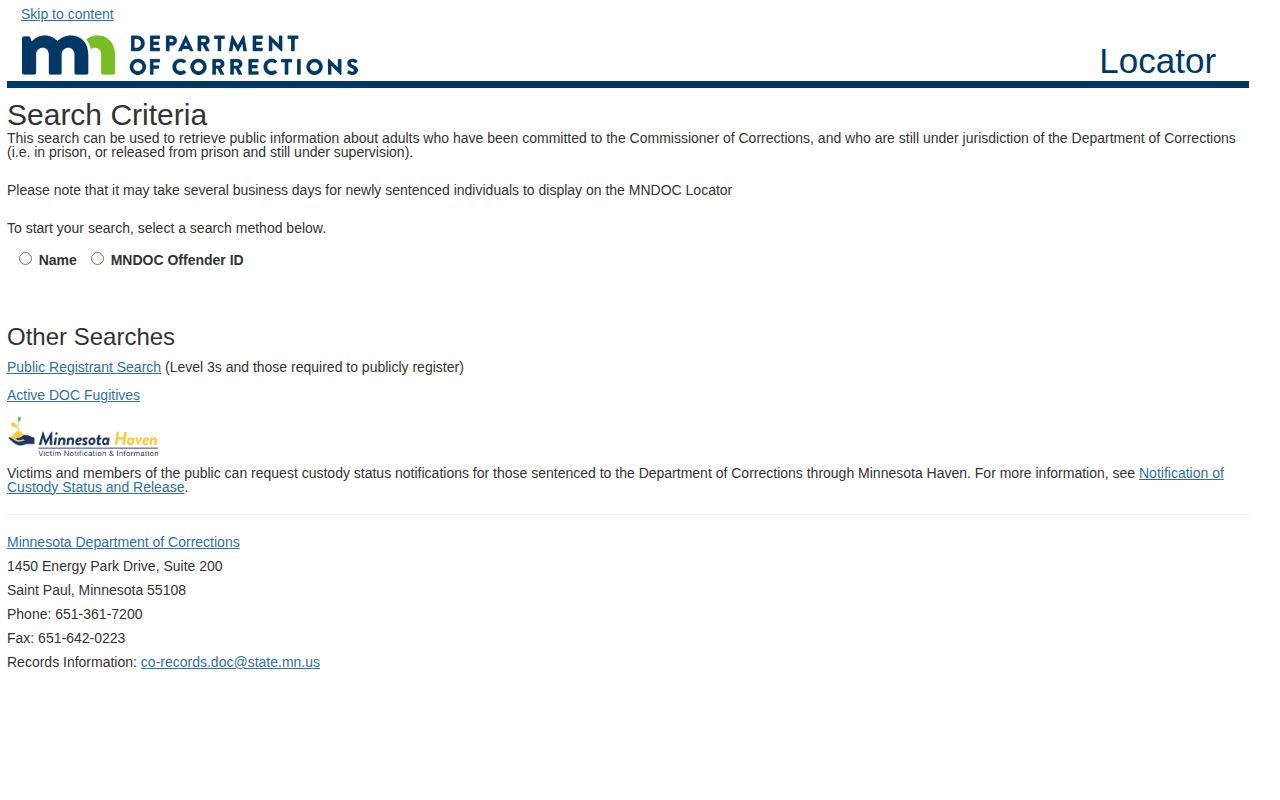
The image helps identify the correct state search. It does not show a Wright County Jail release list and should not be used to infer a date for someone never committed to state prison.
Wright Jail Good Conduct
Minnesota Statutes section 643.29 supplies the county-jail rule. For a person sentenced to at least ten days in a county jail, workhouse, or correctional work farm, subdivision 1 allows one day of sentence reduction for each two days served when the person follows discipline and required labor. Subdivision 2 permits the jailer or superintendent to remove an earned reduction under a discipline plan and later restore some or all of it for mitigating facts.
The ratio alone is not a release calculator. Wright staff must account for credit already served, the sentence start, concurrent or consecutive terms, court changes, another agency’s hold, and discipline. Huber Law work release also does not mean final release. A participant may work outside but must return to the jail during non-working hours until the custodial term ends.
The current Census can carry a calculated Release Date while the person remains held. Ask staff whether it is the present operational date and whether another hold controls. Once the event occurs, Minnesota Statutes section 13.82 supports a request for the actual date, time, and legal basis, plus the recipient if the person transferred.
Note: Wright County publishes no special local weekend rule or daily release hour, so timing questions belong with the jail.
Wright State Release Framework
Minnesota’s ordinary post-1993 fixed felony sentence is not accurately described by a broad “85 percent” rule. Section 244.101 divides the executed sentence into a minimum imprisonment term equal to two-thirds and a maximum supervised-release term equal to one-third. The sentencing court must explain the total term, the prison part, the supervision part, and the chance that discipline can extend prison confinement.
Section 244.05 states that the ordinary covered inmate enters supervised release after the imprisonment term and disciplinary confinement. Added discipline can delay the prison exit and consume time that otherwise would have been in the community phase. The two-thirds point is therefore a framework. It is not an unconditional promise that the prison door will open on a date reached with hand arithmetic.
Once prison release occurs, MNDOC may show “Under Supervision” with the release form and effective date. That is the more useful public confirmation. It also explains why “release date” and “sentence end” are not synonyms. The remaining community phase still carries DOC authority until expiration or discharge.
Wright Earned Release Credit
The Minnesota Rehabilitation and Reinvestment Act adds a distinct state-prison credit path. Section 244.42 applies individualized rehabilitation planning to qualifying people confined in a state facility on or after January 1, 2025 who have at least 365 days to a scheduled release or parole-eligibility point. It also calls for transition planning when the person has less time left. Section 244.43 requires DOC policy that ties earned credit to plan goals.
Section 244.44 caps earned incentive release credit subtracted from imprisonment at 17 percent of the total executed sentence. It also prevents a reduction below one-half of that sentence. Facility-rule violations or criminal acts can cause revocation. Credit moves time from confinement into the applicable community phase. It does not erase the full executed sentence.
The manifest’s official incarcerated Public Viewer detail appears below. Its anticipated date must be read alongside Current Status, Expiration Date, and the linked court record.
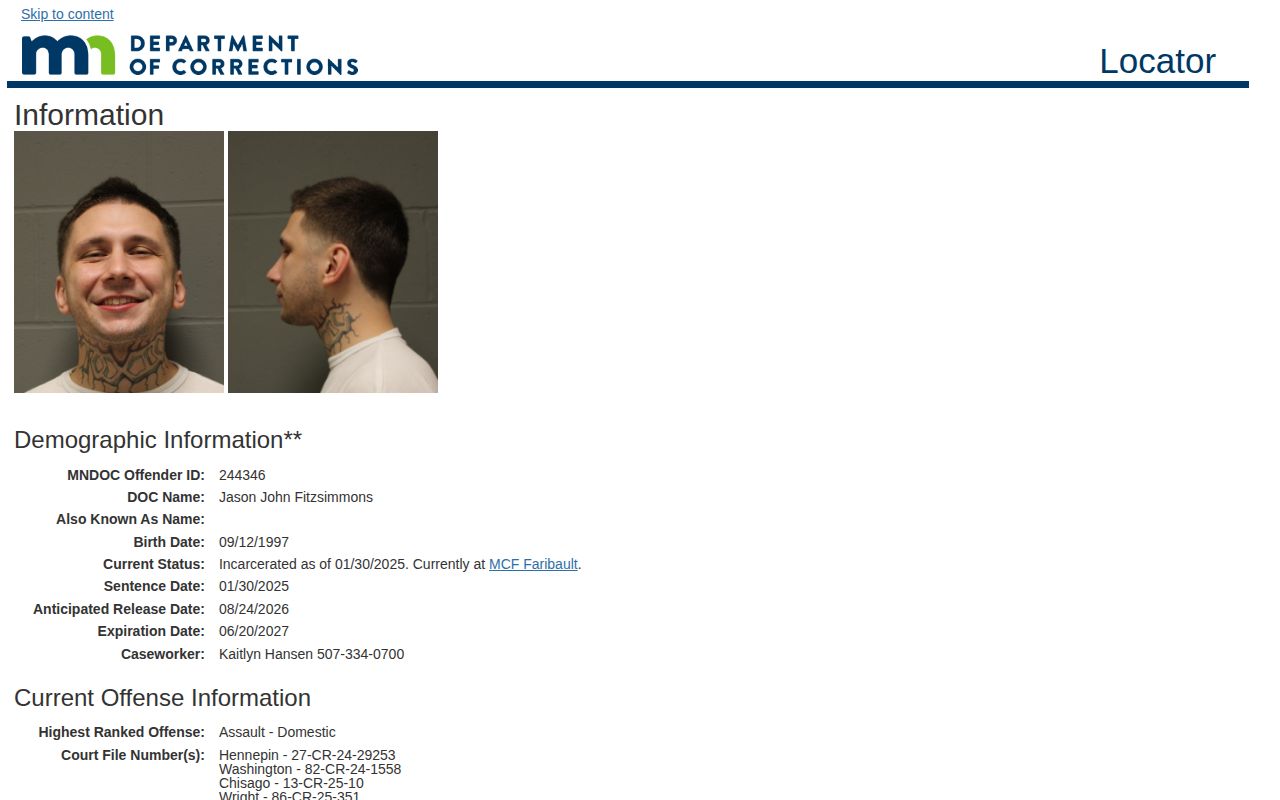
This is an incarcerated example, not proof of an actual release. The caseworker, facility, or Central Records can explain a calculation that later changes.
Wright Release Date Changes
A public date reflects the data and legal state at that point. Wright jail staff and MNDOC may update it when a court sends new paperwork, credit is recalculated, discipline affects earned time, or another authority asserts custody. A change is not necessarily an error. The record needs to be read with the reason for the update.
| Factor | Possible effect | Where to verify |
|---|---|---|
| Jail credit or sentence correction | Moves a county or state calculation | Court order and booking/corrections staff |
| Discipline | Removes county good conduct or adds state disciplinary confinement | Facility or Central Records |
| Earned incentive credit | Moves qualifying state time into the community phase | MNDOC detail and facility |
| Detainer or other hold | Can cause transfer or continued custody after one date | Holding and receiving agencies |
| New or amended court order | Changes sentence, bail, credit, or authority | MCRO and Wright District Court |
| Board action in an eligible case | Sets, changes, or continues a projected date | Supervised Release Board materials |
For a Wright County boarder, disappearance from the census may mean return to the agency in the “Held for” field. Request the transfer recipient before choosing the next locator. A BOP, ICE, or other county record then becomes relevant only if that agency actually received custody.
Minnesota Release Date Quirks
Three rules must stay separate. Wright County jail sentences use the one-day-for-two-days-served good-conduct law. Ordinary post-1993 state sentences use a two-thirds imprisonment and one-third supervised-release structure. Qualifying MNDOC prisoners may also earn incentive credit within the statutory cap and floor. Combining them into one percentage would give the wrong result.
Minnesota also has an offense-date-based state DOC calendar rule in section 244.05, subdivision 1a. For crimes before August 1, 1992, a prison release scheduled for Friday, Saturday, Sunday, or a holiday begins on the prior qualifying day. For crimes on or after that date, it begins on the first later day that is not Friday, Saturday, Sunday, or a holiday. This rule belongs to its precise MNDOC statutory setting.
Do not import that calendar rule into Wright County Jail. The research found no official local weekend or holiday release provision and no fixed daily release-processing time. A Friday or holiday question should go to the jail with the booking and sentence identifiers. For a future custody-event alert, the Wright County VINE inmate check can supplement direct agency confirmation.
Note: A VINE alert records a reported custody event; it does not explain sentence math or rule out every later transfer.
Confirm Wright County Release
After the date arrives, use an event record rather than the old forecast. For Wright County Jail, ask the Sheriff Records unit for the actual date, time, legal basis, and release or transfer code. If custody moved, ask for the receiving agency. Section 13.82 makes those core adult arrest and custody facts public at the originating law-enforcement agency, subject to the statute’s other protections.
For state prison, read Current Status. An under-supervision statement with its “as of” date shows that prison confinement ended while MNDOC authority continues. Contact the assigned unit for a current explanation. For detail beyond the live tool, MNDOC Central Records is at co-records.doc@state.mn.us, 1450 Energy Park Drive, Suite 200, Saint Paul, MN 55108, and 651-361-7200.
The court case supplies the legal basis but may not record the moment staff completed processing. VINE supplies a reported event. The sheriff or corrections record supplies the custody fact. Taken together, those sources distinguish an anticipated date from the release that actually happened.